NewsBridge AI
Designing AI-powered infrastructure for more inclusive, intelligent and accountable journalism in Africa.
A WhatsApp-first platform that helps citizens report in their own languages and helps journalists find and verify stories, with humans making the final call.
Live platform · early-stage adoption and continued development
Visit the live site (opens in a new tab)
- Role
- Co-Founder, Product Designer & Product/AI Strategist
- Client
- NewsBridge AI, an initiative of Grassroot Civic Development Initiative (GCDI)
- Industry
- Civic tech · AI · Media & journalism
- Year
- 2025 – now
Project overview
Connecting the people who witness events with the journalists who investigate them.
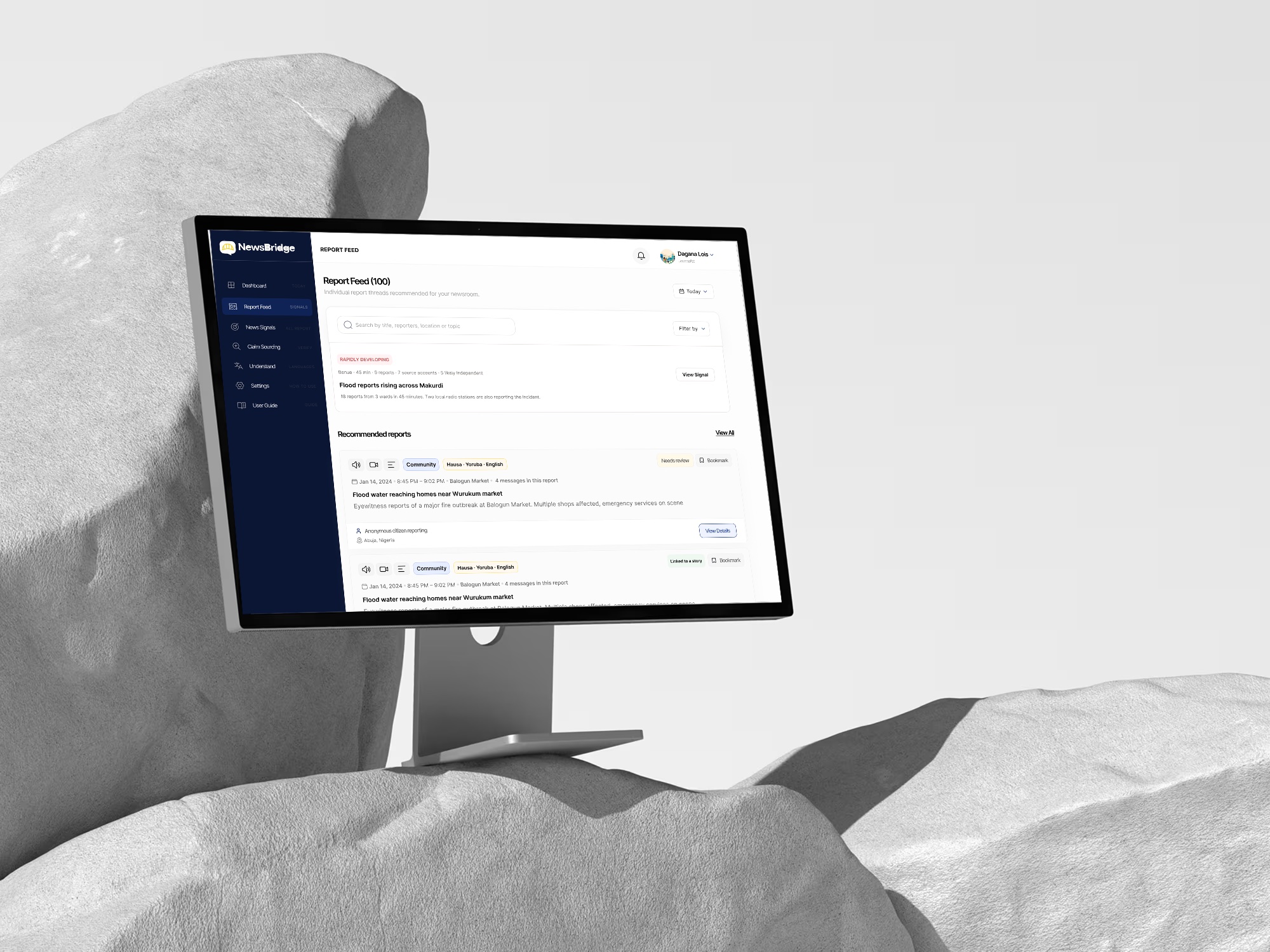
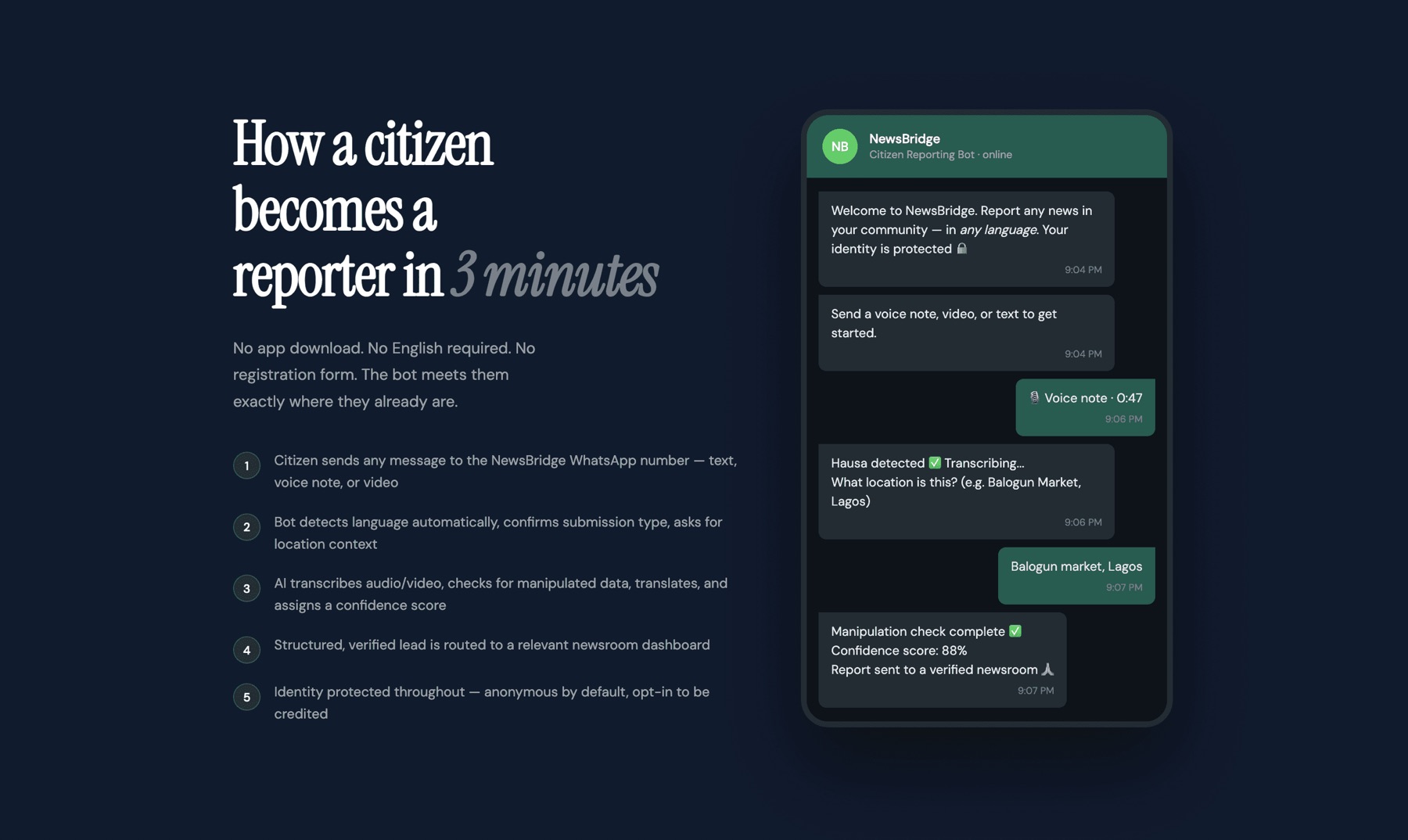
NewsBridge AI began at the CJID Journalism AI Incubator 2.0, where I was one of 38 participants selected from 580. Citizens report on WhatsApp, in their own language, by text, voice, photo or video. AI processes each report, and journalists review it on a dashboard.
I co-founded NewsBridge and lead product strategy and design, which has meant defining the problem as much as designing the solution.
Language Intelligence
Understands reports across languages.
News Signal
Flags potentially newsworthy reports.
Story Intelligence
Finds patterns and possible angles.
Claim Sourcing
Surfaces checkable claims and evidence.
AI assists with processing, discovery and investigation. It never decides what is true or what gets published.
Context & problem
The stories exist. The infrastructure to discover and verify them doesn't.
A woman sends a Hausa voice note about flooding to her family. She doesn't know a journalist or how to file a tip, so the story goes no further. Meanwhile, journalists who want local stories receive scattered, unverified messages, if anything at all.
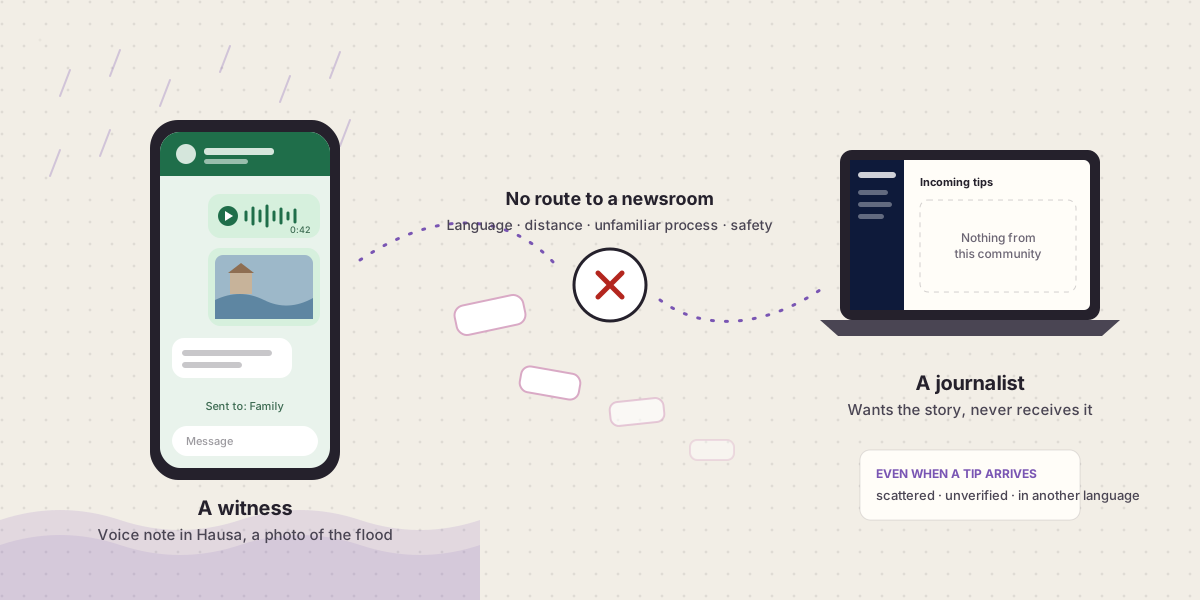
Access
Language, distance and safety keep witnesses out of journalism.
Discovery
Related reports stay disconnected across languages and places.
Verification
A report isn't a fact, and AI can add errors and false confidence.
How might we help citizens report in their own languages, while helping journalists discover and verify stories responsibly?
Our design challenge
Who it serves
Different people, connected by the same information.
Citizen reporters
Report through familiar tools, in their language, with clear anonymity choices.
Journalists & fact-checkers
Find relevant leads and evidence, and stay in control of verification.
Editors
Coordinate newsroom work and keep leads separate from verified facts.
Platform admins
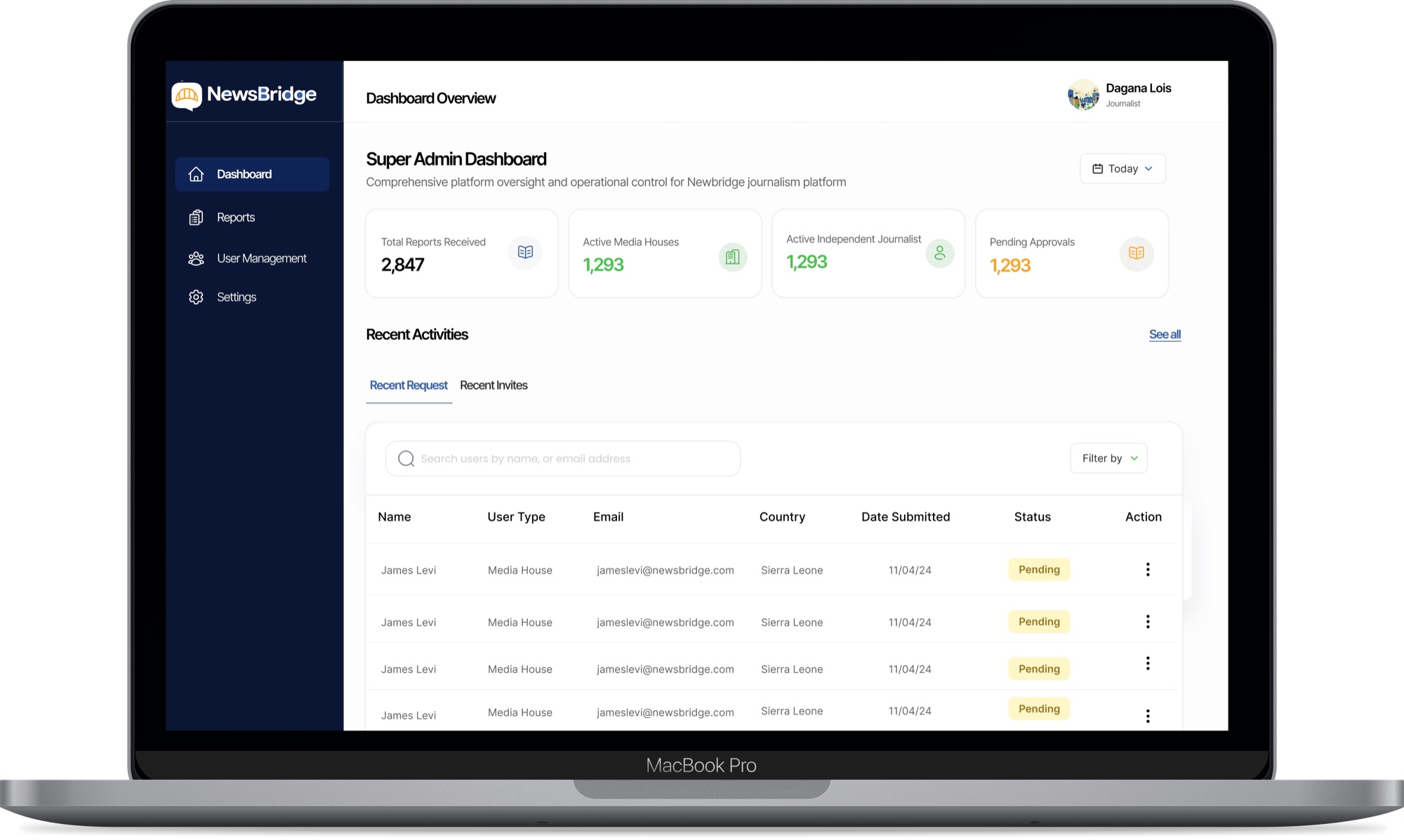
Manage organisations and access, without editorial authority.
Making reporting easy is pointless if journalists get unreliable information, so we designed for the relationship between both sides.
Project goals
Easier reporting, more useful information, accountable verification.
- No new app or complicated sign-up for citizens.
- Language inclusion built into the infrastructure.
- Better story discovery than a chronological feed.
- Support for investigation: claims, evidence and angles.
- Humans accountable for high-stakes decisions.
- One platform for many newsrooms.
These are outcomes we're working to validate, not results already measured.
Research & discovery
Understanding the problem before assuming AI was the answer.
Internal testing and structured critique of the WhatsApp bot exposed four problems: generic fallback replies, lost context across messages, inconsistent multilingual handling, and unclear error recovery.
Conversations with journalism stakeholders, including CJID and Dubawa, showed that AI summaries weren't enough. Journalists need to investigate claims and see evidence, which pushed us towards Story Intelligence and Claim Sourcing.
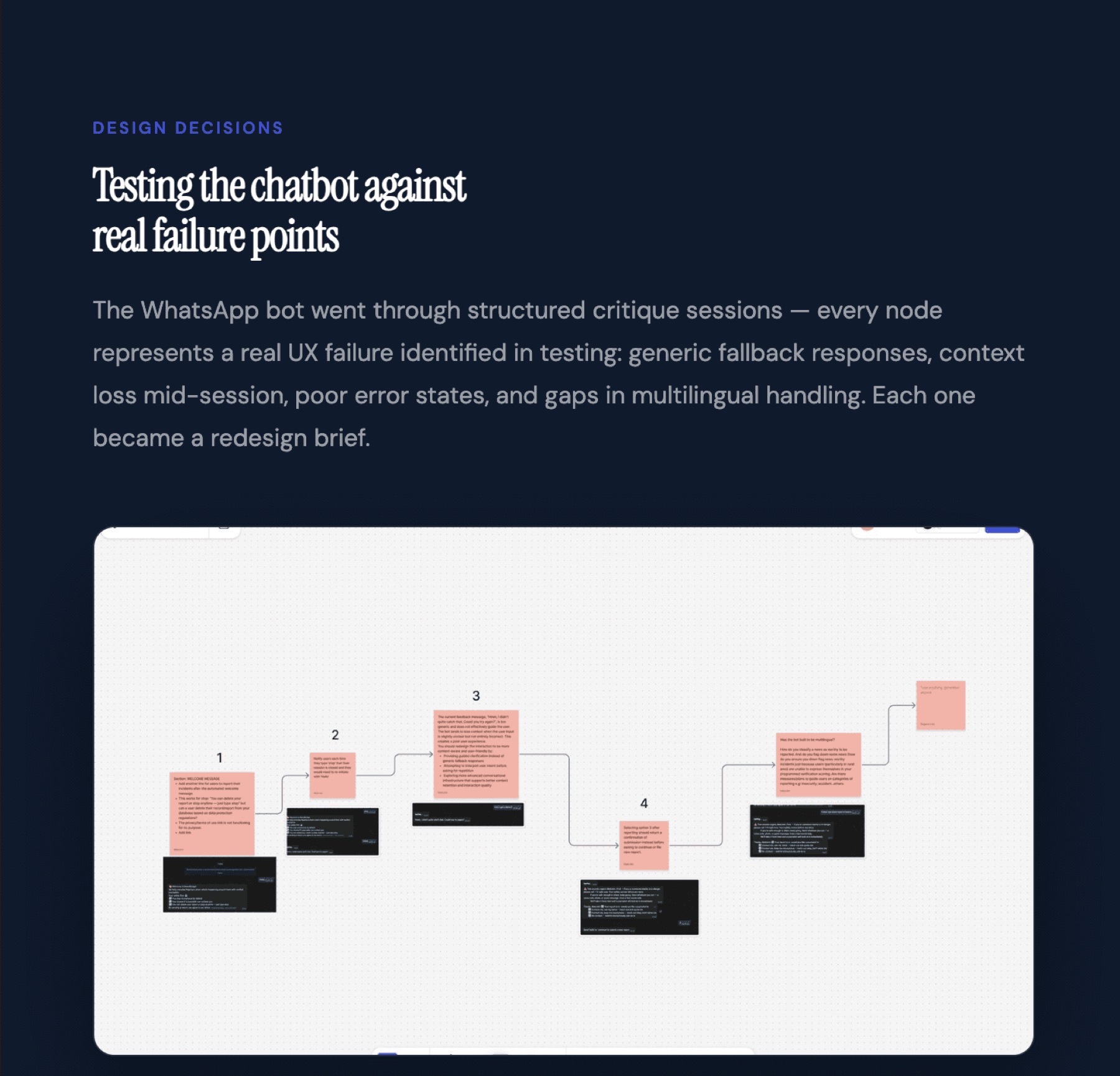
Testing is ongoing. Formal participant counts and usability benchmarks aren't published yet.
Constraints
African realities, not edge cases.
Onboarding friction
WhatsApp, not a new app.
Trade-offExcludes people without WhatsApp or connectivity.
Language diversity
Multilingual processing at the core.
Trade-offAccuracy varies, and translation can lose context.
AI reliability
AI output is assistance, not evidence.
Trade-offHuman review stays essential.
Reporter safety
Anonymous reporting and data safeguards.
Trade-offAnonymity limits follow-up.
Automated filtering
Newsworthiness checks manage volume.
Trade-offA false negative can hide a real story.
Product decisions
From a reporting chatbot to a journalism intelligence workflow.
Meet citizens on WhatsApp
Familiar actions: a message, a voice note, a photo.
What I learnedThe best interface decision can be not adding one.
Keep the original next to the AI version
Translations can strip meaning, so the original stays attached.
What I learnedReadable isn't the same as accurate.
News Signal judges relevance, not truth
It reduces manual review, but can wrongly filter reports out.
What I learnedAutomated filtering is a consequential decision.
Add Story Intelligence and Claim Sourcing
Patterns, angles and evidence, offered as suggestions.
What I learnedThe goal is better questions, not more content.
Journalists stay in control
AI can suggest; it can't verify or publish.
What I learnedDefine what AI may decide, recommend, or must hand to a human.
Information architecture & workflows
Information moves; accountability stays clear.
- Step 01Citizen report
- Step 02Language Intelligence
- Step 03News Signal
- Step 04Journalist review
- Step 05Story Intelligence / Claim Sourcing
- Step 06Human verification
- Step 07Editorial decision
Passing News Signal doesn't mean a report is verified, and not every report becomes a story. That's intentional.
Exploration & iterations
Learning where automation helps and where people need control.
- Clearer bot prompts and error recovery.
- Better handling of reports sent across several messages.
- Moving from one summary to signals, angles and claim sourcing.
- Treating AI confidence as a preliminary signal, never proof.
- Exploring accessibility for people with disabilities, including phone-based reporting, after a question at Build 2026.
Final solution
One platform, four intelligence capabilities, human editorial control.
WhatsApp reporting
Multilingual, anonymous options, no app needed.
Language Intelligence
English, Hausa, Yoruba, Igbo and Nigerian Pidgin.
News Signal
Preliminary newsworthiness, monitored for false negatives.
Story Intelligence
Patterns, related incidents and possible angles.
Claim Sourcing
Claims, evidence and verification checklists.
Journalist dashboard
Built for reviewing leads, not accepting AI output.
Collaboration & implementation
Design, engineering, journalism, AI and governance.
I lead strategy and design, set priorities, and turn user needs into requirements for our engineers, while journalism expertise on the team keeps us grounded in real editorial work.
I'm also building our responsible AI practice: oversight, data protection, model evaluation, vendor management and incident response.
Results & evidence
From a challenge to a working platform.
Selected for the CJID incubator; later a top-three finalist.
Supported languages.
Report submissions in early testing.
Not 500 verified stories.Campus ambassadors onboarded.
- WhatsApp bot, AI pipeline and dashboard deployed.
- Startup Showcase, Deep Learning Indaba 2026.
- Pitched at Build 2026.
This shows delivery and early traction, not yet sustained newsroom adoption or faster verification. The product is live; the learning is ongoing.
Lessons & reflections
How NewsBridge changed the way I work.
- Start from the environment people already use.
- Give every AI feature a clear job.
- Design human oversight across the whole workflow, not just a final approval.
- Treat responsible AI as part of the user experience.
- A working product isn't proof. Evidence is.
Next time, I'd set up measurement and accessibility testing from the very first prototype.